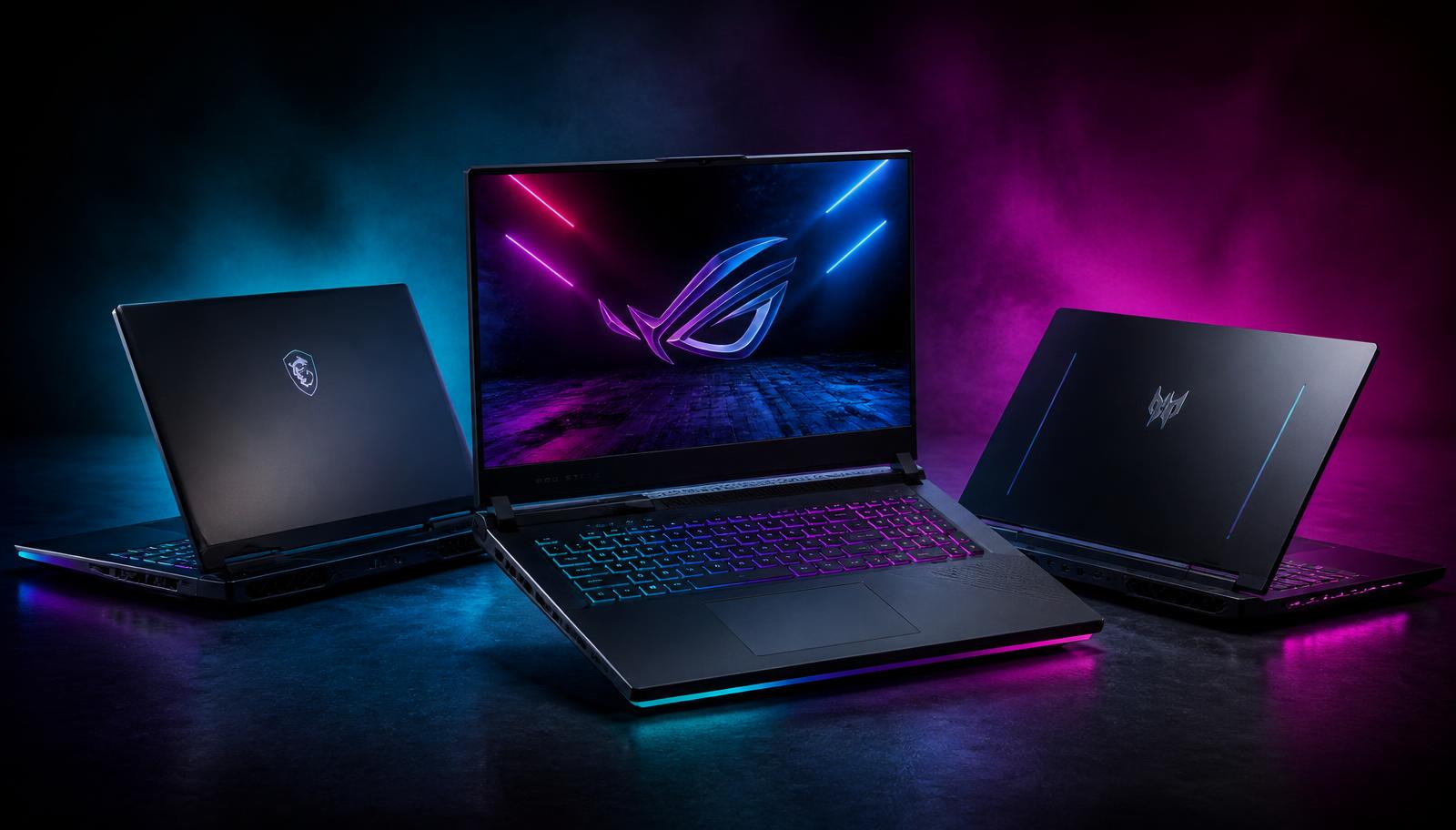
Gaming laptops finally stopped pretending. For years the pitch was desktop performance in a bag, and for years the fine print was throttling, fan noise and a battery that died before your first match ended. In 2026 the top of the market genuinely delivers: the three machines we recommend below held over 95% of their peak frame rates after a full hour of combined CPU and GPU load, at noise levels that no longer require headphones to tolerate.
We spent six weeks and more than 140 benchmark hours with nine flagship laptops. Every machine ran the same suite at 1440p ultra with upscaling off and then on, a 60-minute thermal soak at 22°C ambient, a mixed-use battery loop and an ear-level noise measurement at 40cm. Prices below are what we actually paid, not MSRP fantasy.
Best gaming laptop overall: ROG Strix Scar 18
The Scar 18 is unapologetic. It weighs 3.1kg, ships with a 380W power brick and sounds like a small aircraft at full tilt — and it is comfortably the fastest laptop we have benchmarked. Its RTX 5090 Laptop GPU averaged 148fps at 1440p ultra across our nine-game suite with upscaling off, and after an hour of soak testing it still held 96% of that figure. Nothing else in the test group stayed that flat.
The 18-inch 240Hz Mini-LED panel is the other reason to buy it: 1,300 nits peak, no visible blooming in dark scenes, and colour accuracy good enough that we stopped reaching for a calibration probe. If you want the best gaming laptop in 2026 and the price does not scare you, stop reading here.
Best value: Lenovo Legion Pro 7i
This is the pick we would actually buy with our own money. The Legion Pro 7i averaged 136fps in the same suite — 92% of the Scar 18's result — for roughly $700 less. Lenovo's vapour chamber keeps surface temperatures under 46°C at the WASD cluster, and the machine tops out at 47dB(A), noticeably quieter than the ASUS.
Compromises exist. The webcam is mediocre, the chassis flexes slightly under the palm rest, and battery life while gaming is a flat 2h 10m. None of that matters when you are getting flagship frame rates at a mid-flagship price.
Best portable: ASUS Zephyrus G14
At 1.5kg the G14 is the only machine here you would carry daily without resentment. It gave up real performance — 98fps average at 1440p ultra, and it throttles roughly 12% under sustained load — but it returned 8h 40m in our mixed productivity loop and stayed under 42dB(A). If your laptop has to be a work machine five days a week and a games machine two, this is the trade to make.
How we tested
Every laptop ran a stock Windows install with the manufacturer's latest firmware and NVIDIA's current Game Ready driver, in the highest performance profile available. Our nine-game suite mixes raster-heavy competitive titles with path-traced showcases so the results are not skewed by a single rendering approach. Thermal soaks ran for 60 minutes with logging every second; the sustained figure we quote is the average of the final ten minutes, not the peak.
What to look for when you buy
- Sustained frame rate, not peak: ask for benchmarks taken after 45+ minutes of load
- Total graphics power (TGP) — two laptops with the same GPU name can differ by 40% in real output
- Panel type and refresh: 240Hz OLED or Mini-LED is now standard above $2,000
- Upgradability: two SO-DIMM slots and two M.2 bays add years to a machine's life
- Charging: USB-C PD support means you can travel without the giant brick
Who should skip a gaming laptop entirely
If your machine lives on a desk and never moves, a desktop plus a cheap ultrabook still wins on performance per dollar by a wide margin. Buy a gaming laptop because you need the performance to move with you — not because it looks like a better deal on a spec sheet.